Background: Camp Bonneville Superfund Petition, Submitted by Rosemere Neigborhood Association & Columbia Riverkeeper
In February 2009, following Rosemere’s extensive involvement in what we consider a faulty clean up action plan at the Camp Bonneville military installation, Vancouver WA, Rosemere and Columbia Riverkeeper submitted a formal petition to the US Environmental Protection Agency to list the property on the National Priorities Superfund List.
See the original superfund petition here: http://www.rosemerena.org/home/2009/04/06/preliminary-superfund-petition-for-camp-bonneville-february-3-2009/
The goal of the petition was to bring EPA back into the project in order to correct failing cleanup efforts, currently at a complete standstill. EPA had been a major participant in cleanup efforts more than 10 years ago, but in 2003, EPA withdrew its involvement citing a lack of cooperation from both Clark County government and the US Department of Defense that owned the contaminated property. Camp Bonneville was a former 4000 acre international military training site where munitions, including missiles, grenades, and chemical warfare were used in live drills.
Documented groundwater contamination at the site has entered the Troutdale Aquifer System, a federally designated Sole Source Aquifer that was petitioned by Rosemere and Columbia Riverkeeper and established in 2006. The source of the contamination is a vast collection (both known and unknown) of buried military munitions and chemicals that have leached into the soil and groundwater throughout the site. Rosemere contends that the plume of toxic chemicals has been mobile for many years, and may have exited to compound, threatening Lacamas Creek and its tributaries, and Lacamas Lake which is hydrologically connected to the Columbia River.
Water Main Break – September 26, 2009
Rosemere residents were unwinding from a busy week on Saturday night, September 26, 2009.
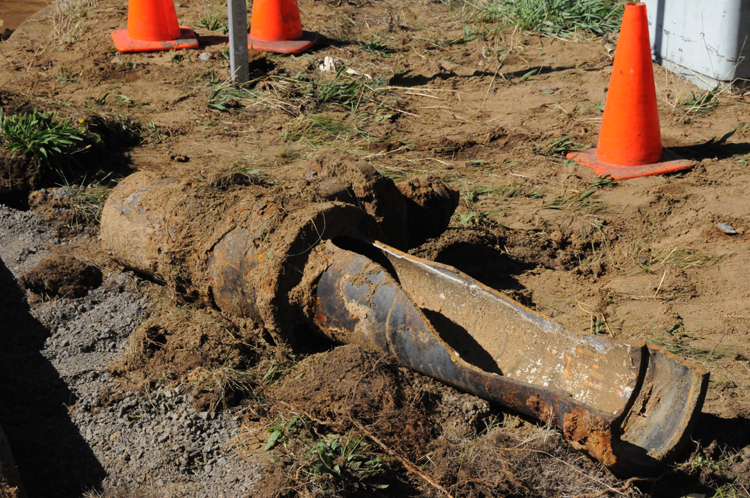
As relaxing bubble baths were being drawn, water ceased flowing. Those with shampoo in their hair found this most inconvenient, but employees of the City of Vancouver who were wrestling with a broken water main on 32nd & Q St. had bigger problems.
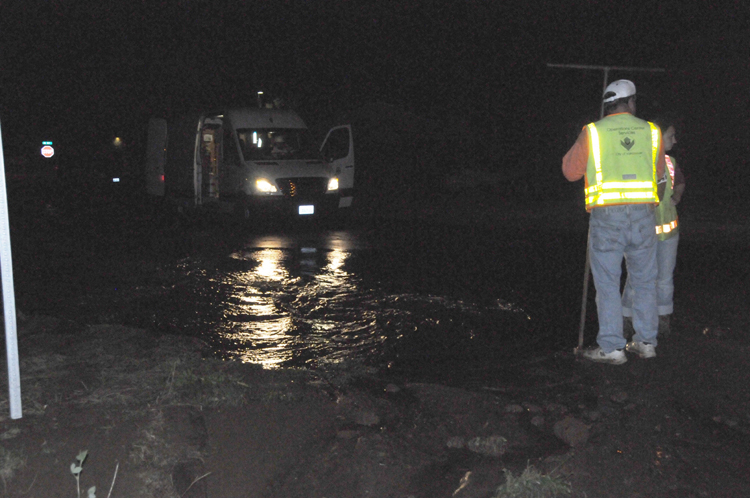
In inky darkness, water was shooting out of the broken main, creating a sinkhole which overflowed, flooding the streets. A city employee was probing the massive hole to test for depth. Suddenly the edge he was standing on gave way, plunging him into the raging waters. After swirling around in the maelstrom for what seemed an eternity, he was able to extract himself to safer grounds.
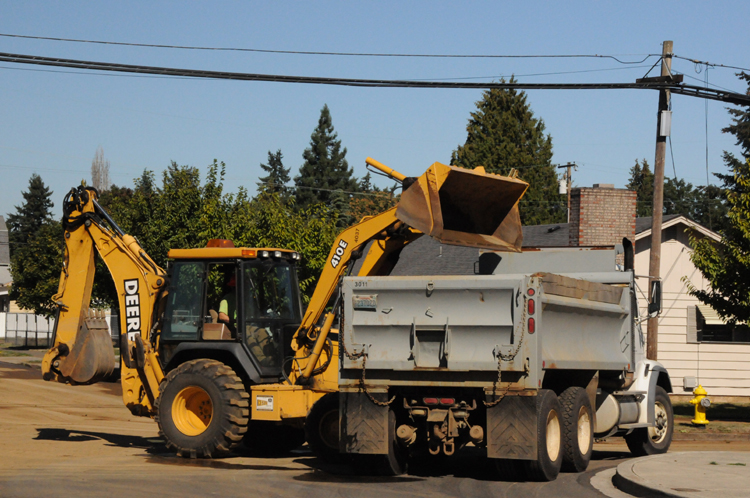
Water flowed down 32nd towards R St., turning the alley into a churning creek, flooding a home on the corner. The area was a news clip disaster. By Sunday morning, hard working city employees repaired the broken main and filled the sink hole.
In August, Environmental Protection Agency (EPA) opened a public comment period regarding the potential health impacts from exposure to perchlorate through drinking water. EPA is re-evaluating the need to collect data on the level of health concern, the frequency of occurrence of perchlorate in drinking water, and the opportunity for health risk reduction through a [...]
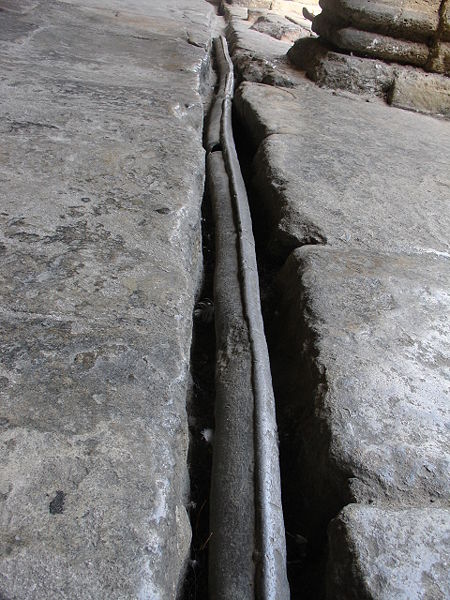
Ancient Lead Pipe, Bath, England
The solution to the lead issue in drinking water would optimally be replacement of all lead piping.
However, there are certain issues:
The ownernership of the lead piping is between the supplier and the property owner, leading to possible legal aspects.
The replacement costs are very high. Approximately 8-10 billion sterling pounds to replace all lead piping in the UK
The density of properties with lead piping can be up to 75% in many cities. The replacment program would create much disruption to road users and property owners
When the lead in water is not visible, tasted, odorless, it is not perceived as a problem. Property owners are then reluctant to take expensive actions.
Corrective Treatment
The European Drinking Water Directive of 1998 tightened overall standards for drinking water in Europe. As a result, steps have been taken in England and Wales to reduce lead concentrations and mitigate lead poisoning in drinking water.
Lead in drinking water can cause a variety of adverse health effects. In babies and children, exposure to lead in drinking water above the action level can result in delays in physical and mental development, along with slight deficits in attention span and learning abilities. In adults, it can cause increases in blood pressure. Adults who drink this water over many years could develop kidney problems or high blood pressure.
Lead pipes were used in the UK up to the 1980s both for connecting a property to the water supply main and for internal plumbing, due to lead’s strength, malleable nature and resistance to corrosion. In the UK, about 40% of properties are supplied via a lead pipe. Elsewhere in Europe, the estimated percentage of properties supplied by lead pipe-work varies from 5% to 50%.
Soap bubbles with cute smiling faces, sliding joyfully around a tub and shower, who wouldn’t want to buy what these animated little darlings want to sell you? But no matter how endearing, the only reality of the never ending need to clean our shower and tub is, as our parents used to say, “elbow grease.” A good scrubbing with a green scrubber and a non toxic product is the only way to clean a bathroom.
Posted 9 pm, August 14, 2006
As of 3:00pm on Monday, August 14, 2006, the Troutdale Aquifer System in Clark County, WA, has been officially designated as a Sole Source Aquifer by the Environmental Protection Agency. CLICK HERE TO VIEW THE EPA FEDERAL REGISTER NOTICE.
On December 4, 2005, a petition was formally submitted to the Environmental Protection Agency (EPA), Region 10, Seattle, requesting that agency to designate the Troutdale and Unconsolidated Alluvium Aquifer System in Clark County, Washington, as a Sole Source Aquifer. The EPA defines the Sole Source Aquifer Program as a tool used to protect drinking water supplies in areas with few or no alternative sources to groundwater resources, and where if contamination occurred, using an alternative source for the potable water supply would be extremely expensive.
To qualify for Sole Source Aquifer designation, the proposed aquifer service area must prove to be at least 50% dependent on groundwater for the potable water supply. Factual analysis shows that 99.4% of the potable water currently used in the proposed Sole Source Aquifer service area in Clark County is obtained from groundwater, confirming that the Troutdale Aquifer System qualifies as a Sole Source Aquifer. READ MORE HERE
On December 4, 2005, a petition was formally submitted to the Environmental Protection Agency (EPA), Region 10, Seattle, requesting that agency to designate the Troutdale and Unconsolidated Alluvium Aquifer System in Clark County, Washington, as a Sole Source Aquifer. The EPA defines the Sole Source Aquifer Program as a tool used to protect drinking water supplies in areas with few or no alternative sources to groundwater resources, and where if contamination occurred, using an alternative source for the potable water supply would be extremely expensive.
Materials collected from workshop on Septic Tanks and Private Wells
Intro:
We attended a special workshop for homeowners on how to properly maintain septic systems and private wells on their property, how to prevent costly repairs, and how to protect drinking water from contamination. This workshop was presentd by the Washington State University Cooperative Extension and Clark County Health Department, and it was sponsored by Clark County Clean Water Program, and Clark Conservation District.
Well water quality is just as important as quantity, but easier to overlook. There is rarely a clear signal when microorganisms, nitrates, pesticides or VOG’s (volatile organic compounds) contaminate well water. Yet these contaminates do make their way into private wells. Homeowners who choose the “blinders” approach, assuming that their well water is OK, are taking a gamble with their health. The potential risks are kidney and nervous system damage, intestinal illness, cancer and birth defects. According to a US Geological Survey, many wells in Clark County and Vancouver were tested and found to contain contaminates.