Rosemere Neighborhood Association Rotating Header Image

Posts Tagged ‘columbia river crossing’

PEAC Comments on Final Environmental Impact Statement for I-5 Columbia River Crossing Project

Pacific Environmental Advocacy Center (“PEAC”), the Environmental Legal Clinic of Lewis & Clark Law School, has submitted comments on behalf of a coalition of environmental groups on the Columbia River Crossing Project (“CRC”) Final Environmental Impact Statement. PEAC clients include Rosemere Neighborhood Association, Coalition for a Livable Future, the Northeast Coalition of Neighborhoods, Northwest Environmental [...]

Letter to Oregon Legislators Outlines RNA Concerns Over Columbia River Crossing Environmental Impact

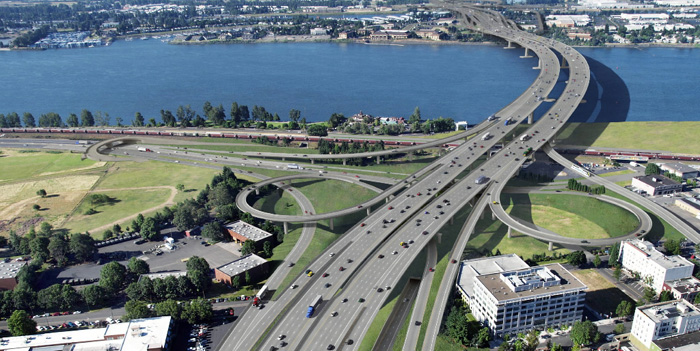
I-5 Interstate Bridge Over Columbia River
Columbia River Crossing (CRC) has spent more than 5 years and $100 million dollars on the proposed Interstate 5 Bridge crossing. Rosemere Neighborhood Association has been monitoring CRC progress, raising numerous concerns over CRC environmental impact statements (“EIS”) and CRC adherence to National Environmental Policy Act (“NEPA”) rules.

Attorney Tom Buchele, Managing Attorney & Clinical Professor for the Pacific Environmental Advocacy Center (PEAC) at Lewis and Clark Law School, on behalf of RNA, Coalition for a Livable Future and Upstream Public Health, has sent a letter to the Oregon House Transportation and Economic Committee regarding the upcoming consideration and hearings on Oregon House Joint Memorial 22 (HJM 22). Oregon’s HJM 22 urges the federal government to fund the Columbia River Crossing Project.

Mr. Buchele’s letter details his concerns about the legality of the CRC’s NEPA analysis to date:

The CRC staff, and the state and federal agencies supporting this project, have already made a serious error regarding the bridge design. My letter highlights their multiple serious legal errors regarding compliance with NEPA. It would be an equally serious error, and a waste of even more taxpayer money, for this committee to simply rubberstamp the CRC’s mistakes by passing HJM 22 and thereby endorsing this project before those mistakes have been fully corrected.

To read Mr. Buchele’s letter to Oregon House Transportation and Economic Committee in full, click here: http://www.rosemerena.org/home/wp-content/uploads/2011/04/TomBuchele_PEAC_CRC_letter_to_Oregon_House_Transp_Comm.pdf

To read Mr. Buchele’s Executive Summary of CRC DEIS Comments: http://www.rosemerena.org/home/wp-content/uploads/2011/04/TomBuchele_PEAC_Exec_Summ_DEIS_Comm.pdf

To read Mr. Buchele’s Testimony Before CRC “Independent” Review Panel, July 2010: http://www.rosemerena.org/home/wp-content/uploads/2011/04/TomBuchele_PEAC_IRP_testimony.pdf

Columbia River Crossing Project Environmental Impact Analysis

I-5 Interstate Bridge Over Columbia River

In Summer 2008, a Draft Environmental Impact Statement (DEIS) was released on the Columbia River Crossing Project, and various environmental organizations, including Rosemere Neighborhood Association, submitted public comment to show that the draft document was incomplete and full of data gaps. Concerns were also raised regarding the draft’s compliance with the National Environmental Policy Act.

Since the release of the DEIS, Rosemere has met several times with Columbia River Crossing (CRC) staff and has raised concerns regarding the project’s impact on the environment, including the aquifer system that provides Clark County residents with drinking water and local streams within the construction footprint.

In 2005, Rosemere submitted a petition to EPA requesting that agency to designate the Troutdale and Unconsolidated Alluvium Aquifer System in Clark County, Washington, as a Sole Source Aquifer. The EPA defines the Sole Source Aquifer Program as a tool used to protect drinking water supplies in areas with few or no alternative sources to groundwater resources, and where such an aquifer is vulnerable to contamination. Sole Source designation requires at least a 50% dependence on an aquifer for its potable water supply. Factual analysis provided by Rosemere and its partners shows that 99.4% of the potable water used in Clark County is obtained from groundwater. In August, 2006, EPA officially granted Rosemere’s petition and designated Clark County’s Troutdale Aquifer System as a federally protected Sole Source Aquifer. One of Rosemere’s goals was to ensure adequate environmental review of the CRC project under the federal Sole Source Aquifer program.

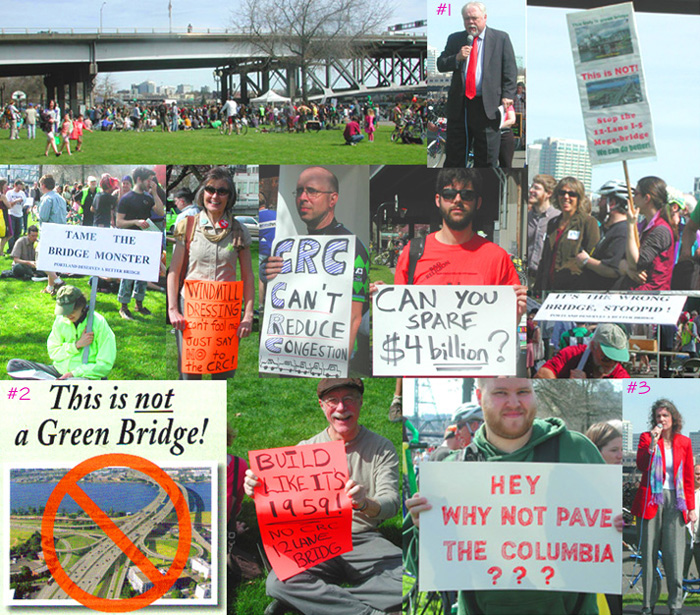
Rally Organized to Oppose the 12-Lane Columbia River Crossing – April 5, 2009

#1 Senator Don Benton (WA), #2 Association of Oregon Rail & Transit Advocates, #3 Portland City Commissioner Amanda Fritz

It was the perfect day for a rally, the first nice spring day in the region. It took place at the noon at Tom McCall Waterfront Park in Portland amidst freshly sprouted lawn, trees starting to blossom, a sunny blue-sky day, and a busy promenade with bicyclists, strollers, and roller skaters. Television crews buzzed about as the stump speeches began beneath the Hawthorne Bridge. Sponsors of the rally included the Bicycle Transportation Alliance, Coalition for a Livable Future, 1000 Friends of Oregon, Upstream Public Health and Oregon League of Conservation Voters. Speakers included Washington Senator Don Benton, Portland City Commissioner Amanda Fritz, and Former Oregon Secretary of State Bill Bradbury.

EPA ADDRESSES THE COLUMBIA RIVER CROSSING PROJECT – July 8, 2008

Letter Originally Dated July 1, 2008

(posted 12:15 AM, July 9, 2008)

The U.S. Environmental Protection Agency sent a letter, dated July 1, 2008, to officials in the Federal Highway Administration and the Federal Transit Administration. “The U.S. Environmental Protection Agency has reviewed the Interstate 5 Columbia River Crossing Project Draft Environmental Impact Statement (DEIS) and Draft Section 4(f) Evaluation. We are submitting comments in accordance with our responsibilities under the National Environmental Policy Act (NEPA) and Section 309 of the Clean Air Act.”

COLUMBIA RIVER CROSSING STAFF SPEAKS AT RNA MEETING – June 22, 2006

In December 2001, Rosemere residents on ‘K’ street learned that they could have lost their homes to make way for a potential I-5 widening project. The RNA received many phone calls from worried neighbors when this issue first arose in a Columbian article entitled “In the Way on ‘K’,” and RNA members became very active in public meetings with the Bi-State Transportation Commission that was established to help find solutions to traffic problems relative to the I-5 bridge crossing. The RNA canvassed the neighborhood and rallied residents to attend Commission meetings and provide written and verbal testimony in order stop unnecessary demolition of homes that abut I-5. The message was loud and clear, and Commission members acknowledged that design plans should be changed to ensure that homes were not lost in Rosemere and other neighborhoods.

Videos, Slideshows and Podcasts by Cincopa Wordpress Plugin